THURSDAY
Neither one of us has a machine, unfortunately.
On her way past the café, Isabel sees us, waves, and mouths through the window: "Bon appetit!" Has El Barco Marisco become our Flore? La Condesa notre Deux Magots?
To pass through customs,
of course, is for Daniel another identity-defining experience. Another
experience of betweenness. And another impersonal form of public approval.
As the work of art must be made to fit within the specs of the post office,
so must the person shape an identity within the constraints of power.
Customs is a socially constraining force –
about this the individual has no control. Or rather, the individual yields
control and power through enforced acceptance of membership in a collectivity,
a nation state. This is a given for most people and accordingly it's given
little thought. For the artist, whose life is in a sense inseparable from
the work, the constraint is accepted willingly. In one sense, the
artist becomes more conscious than others of life's constraints, but at
the same time, by making a formal principle of the idea of constraints,
one re-asserts a kind of control over them. 

Daniel once identified the contents of a taped object with the word, "AIR," before sending it overseas. Customs cut through the tape and cardboard, saw that it contained only what had been declared, and then – what else? – taped the incision shut before sending it on.
That's how the piece went to the gallery. At which point – Daniel is in agreement with all gallery owners and curators – it must not be touched. Damage en route is part of its identity; it's not reproducible, and it shouldn't be encouraged past a certain point – that is, past the point when the work goes public. Damage in the gallery would decrease the work's value. The two systems, creation and exhibition, are distinct, and it's a mistake to confuse them.
Colliding systems. The difficulty with metric conversions is not knowing that an inch is 2.54 cm. The problem is that you have to think differently in going from one system to the other.
Daniel's method: to give up some of his own agency and creative power to the accidents of a work's circulation, as it works its way through modern systems of communication and transportation. Using the system as a kind of co-author or collaborator, the living artist points a direction through a lifeless long network.
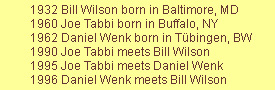
Isabel returns with a package from the Home of Seafood. Daniel's been sending the word around. And word's gotten around, evidently, about the interview as well. Isabel asks, will there be a biography? I explain my intention to include only what Daniel tells me, at the place where it occurs in conversation. The less biography the better, with nothing best of all – as Bill Wilson suggested for himself in one of his letters concerning his own contribution. But you must record the conversations, uh-huh? She'll look to see if she has a machine for us.
In the same letter, however, Wilson also mentions a decalcamania that Picasso glued into a sketchbook, about the season he met Georges Braque. (The first use of tape in modern art?) Documenting a life as it is lived, the time and its record – is this not preferable to biographies that supplant the life?
They've shut down Edmar Foods on Chicago Avenue, where Daniel and a handful of aged Ukranians used to get their bread, welfare cheap. Ginza Health Bread. Sent in from Bruno's bakery on the South Side and made according to a recipe from the Himalayas.
Robert Crumb's younger brother
Charles Crumb, a suicide,
in his work would focus repeatedly
on one particularly well-known piece of English literature, having to
do with the relationship between an old man and a boy. Initially, his
drawings contained very little text; later, as the drawings become smaller
and smaller, one finds almost the entire page filled with text. His last
works are books, without margins, filled on every page with pure calligraphy.

In the afternoon mail, Staples gives me a free roll of "invisible" tape, which I won't read as a sign, yet it does seem to designate.
.

