ARTIST STATEMENT
Digital images can be printed or transformed into paintings or sculpture or books, but their principal form is as images. In addition, computer generated images may also be shared freely as electronic data. As such, digital images are among the most ephemeral of our time; perhaps even more so than photographs, films, or video.
Since about 1968, when I first became aware of the international movement known as Concrete Poetry and the work of Jasper Johns, I have been interested in the unique relationship of words and images. Some general themes of my recent work are sex, humor, perception, language and art itself. I try to work as an artist/medium rather than artist/master. I'm more interested in discovering or revealing art rather defining or asserting it. To that end, I have used verbal or mathematical structures to determine the visual form. The computer is especially suited to this kind of procedural or algorithmic method of composition.
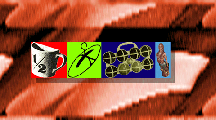
The "Index" series of prints consists of compositions derived from verbal as opposed to visual structures. The artist's book, Index, was created explicitly for the purpose of functioning as a reference for these pictures. GOOD LUCK simply uses the phrase "good luck" indexed by the images which correspend to the letters in the book. The titles of a number of other prints are indexed by the images as well, such as FINAL FRONTIER and THREE WISHES.
The images were not paired with the letters of the alphabet for their visual similarity (although some are similar in form) but in a more or less random way. I wanted to "see" what pictures would result from arbitrary associations and, in that sense reveal, rather than impose meaning. In the "Indexed" works one would need to have the Index book to "decode" the work, but I don't think that they depend on a literal reading for their esthetic significance.
Another series of works feature the use of a typeface based on human skeletons. These installations, prints and books employ the simultaneous creation of words and pictures. In some cases, one sees the pictures of the skeletons first and then notices the words they form. Likewise, at other times, one may see the word first and the picture secondly.
Recently, I have been arranging alphabets and words printed on transparent plastic sheets. In these works the wall functions for the letter as the page does in normal circumstances and emphasizes the fact that we read word pictures, not just letters.
Jim Johnson has been a member of the Painting and Drawing faculty of the
Department of Fine Arts at the University of Colorado at Boulder since
1970. He developed the department's Computer Imaging program and
produced over 60 videotaped interviews with participants in the
Department's Visiting Artist Program. His work is in the collections of
the Museum of Modern Art, N.Y, the Denver Art Museum and the Minneapolis
Museum of Fine Arts.