farts cringe at the sound of rock and roll blasting from the
speakers of a passing muscle car, or after accidentally beaching
on MTV while channel surfing. Though the cliche may be obsolete
as America's parents consist more and more of veteran rock and
rollers, there is something timeless about rock's capacity to
offend. Just as rock and roll will never die, rock and roll's
critics won't either. They're as old and ornery as ever.
It's always been funny to rock fans that critics have
been plagued by an inarticulate understanding of the music they
love to hate. It just sounds bad to them. It's a racket, an
indistinct chaos. It's a redundancy of noise. The curmudgeons
who reject rock music aren't interested in listening to it at
all. Yet, considered beyond its capacity to spontaneously repel
or attract listeners, it's clear that the soul of rock and roll
is distortion. It sounds like a buzz saw, and you either love
it or hate it.
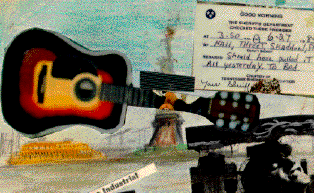
The distorted electric guitar is so central to rock music that
even serious listeners and musicians are scarcely aware of it
as an affectation. Distortion is the sine quo non of rock,
which perhaps explains the awkwardness one has in trying to name
it and talk about it. It has the same kind of ill-fitting and
clumsy names that we normally associate with taboo topics.
On the one hand, there are the sterile clinical denominations
such as "distortion" and "saturation." On the other hand,
there are the faintly off-color poeticisms like "fuzz" and
"buzz." But it's clear, especially in our hyper-categorized
culture, that it's probably not rock music in any meaningful
sense if the electric guitar doesn't have the raspy burr of
an overdriven signal. Given the overwhelming and long term
popularity of rock music, it seems odd that there aren't
more words for this defining feature. To be sure, purists
have developed a language of metaphor and simile for variations
of distortion, such as "crunch," "grunge", "dirty", and "tinny."
But this vocabulary is nearly as remote and bootless -- not
to mention annoying-- as that of the professional wine taster.
What is it about the sound of buzzing and wailing guitars that
causes one generation to gnash its teeth, and another to mosh
in the pit? The answer is deeply buried beneath layers of
cultural meaning.
In her book Natural Symbols, Mary Douglas argues that modernity
is a cultural trend away from "condensed symbol systems" toward
"elaborated language and signs." This means that the ways we
communicate are becoming more and more concrete and precise.
In the modern age, old symbols like the Christian Cross or
Motherhood lose their abstract impact as they become loaded with
all kinds of apology and explanation and elaboration. A good
example of this trend is the way our understanding of mental
illness has evolved in the last 100 years. Before the modern
period, maladies like schizophrenia were often seen as demon
possessions, explained by heavily symbolic words like "Grace,"
"Christ," and "Unclean Spirit." With Freud and the genesis of
modern psychology, we began to speak of the same phenomena in
elaborate psycho-scientific terms with precise definitions,
stripped of symbolic impact. In modern times, symbolism is
often seen as an obstacle to understanding, a kind of encryption
that blocks clear thinking.
This precision of language is a sort of division of labor on a
semantic level. It's the lingual equivalent of modernity's
general trend toward more and better industry. Elevating science
and technology is the m.o. of modernity, and reflects what is
happening to our systems of communication and signage. We have
learned to manipulate our material conditions so effectively that
our natural theology, which once saw God behind the curtain of
nature, has been replaced by an elaborated scientific language
of Physical Laws. It would seem that we get better results
from experimentation than prayer.
In the post-modern period, it has become a convention to question
the wisdom of discarding our old "condensed symbols." It's not
that we want the old ones back; it's just that we suspect they
want replacing. There's a growing recognition of the vacuum of
meaning left in the wake of technology, industry, and scientific
elaboration. Precision of language and ideation is itself
criticized as misleading, unrealistic, and unpleasant. Rock
music can be seen as a general cultural expression of this
reaction. It disputes elaborated systems and modernity's
mandate for precision. The central vehicle of this rejection
is distortion.
Of course, "distortion" is a term with negative connotations.
It's often used this way when we speak of someone misinterpreting
or misrepresenting the facts. But "that's a distortion" is not
the same as "that's a lie." Using the term "distortion" is one
way of saying "that's a lie" when we presume that finding or
knowing Absolute Truth isn't really possible. As the historian
Jacques Barzun once said, "truth" in the modern age is an
abbreviation of "truthfulness," and a distortion of truthfulness
isn't an outright lie.
In music, the term is more neutral. It's simply a physical effect
applied to sound. Distortion is the degradation of a pure signal
by the addition of interference, often through a little device
called "a fuzzbox." To illustrate, there are numerous other
effects that are frequently applied to the pure signal of
electric music. Reverb, wah-wah, and chorus are all good
examples of effects which are commonly applied in rock music--
as well as country, folk, new age, and even classical music.
Most of these other "effects" aren't so much a "degradation"
as an enhancement or an embellishment of sound.
Of course, a very important premise is the fact that most
contemporary music is brought out through electronic
circuitry. Rock and other popular forms of music are
almost completely dependent on the medium of electricity.
This dependence is central to the phenomenon of distortion,
and provides the physical and cultural motive for the
fuzzbox.
In the language of the physicist, distortion takes a smooth
sound wave-- represented by an s turned on its side-- and
squares off the apogees. This gives the sound a rasping or
rattling sound, and is affected through a variety of methods.
The earliest technique was to play at excessive volume,
exceeding the limits of the amplifier's speakers. When
the distorted signal was found desirable, early rock and
roll musicians played through accidentally and intentionally
damaged amplifiers. Distortion today is applied electronically,
by running the guitar signal through a foot-operated pedal or
similar device. In concert with the countless other "effects"
used in modern rock and roll, distortion is the titanium white
of the electric guitarist's pallet.
The origin of fuzz is obscured in history. Where did it come
from and why was it desirable? One theory is that early rockers
wanted to mimic the sound of the saxophone, which started to
sound sloppy when it was played with vigor. To be sure, the
saxophone was the solo instrument of choice in the earliest
days of rock and roll. It was slowly supplanted by the electric
guitar. But this simple explanation sidesteps the question
of why this ragged quality of sound was desired in the first
place.
The answer to that question lies in the origins of electric
music in the thirties. While big band music still ruled
popular taste, Benny Goodman hired guitarist Charlie Christian
for a brief but provident stint. As Andreas Segovia has
pointed out, the acoustic guitar is an extremely intimate
instrument. This asset is also its weakness, because it
can't be accompanied by an orchestra or a band without
being drowned out.
The acoustic guitar has long been a favorite popular instrument
among Americans because of its portability and intimacy. For
example, in a 1965 swell of interest guitars outsold pianos 6
to 1, and all other stringed instruments 22 to 1. But while
the classical guitar makes a fine solo instrument, it doesn't
accompany louder instruments very effectively. For this reason,
Charlie Christian secured an electro-magnetic pickup to his
acoustic guitar in 1939, in order to be heard above the din
of Goodman's horns and drums. Fatefully, the limitations of
this early technology were soon apparent. Historian Chris
Doering wrote, "The pickup reproduced only the midrange
frequencies of the instrument, cutting off all the high
overtones that give the acoustic guitar its character.
And when Christian tried to fatten up his sound a little
by turning up the volume and bass controls on his suit-case
size Gibson amp, the poor little thing freaked out and
started distorting for all it was worth." Most historians
of popular music agree that in this failure of technology,
a new instrument with unique qualities and potentials was
born. It wouldn't be long before the new instrument gave
rise to a new music form.
The first musicians to really exploit the possibilities of
the new instrument were black bluesmen like Muddy Waters and
Guitar Slim. Like Charlie Christian, they used the electric
guitar in musical self defense, in order to be heard above
the raucous stomps of a blues jam. Waters and Slim increased
the volume until their guitars bawled with distortion, finding
that it incited near-riots in their audiences Sam Phillips at
Sun Records was one of the first engineers in the recording
business to recognize the rich possibilities of the distorted
electric guitar. When Ike Turner and his band The Kings of
Rhythm drove to Sun Studios from Mississippi to record "Rocket
88"-- commonly cited as the first rock and roll record-- one
of the guitar amps fell out the back of Turner's car, and
ruptured its speaker cone. Phillips decided they didn't
have time to get the amp fixed, so he stuffed a wad of paper
in the damaged diaphragm, liked what he heard, and recorded
the song. An accidental failure of technology created a
desirable sound-- a sound that would eventually define a
whole multi-billion dollar industry.
It's long been acknowledged that rock music glorifies
temporality-- the here and now-- by sanctifying self-
destruction. Perhaps the most radical manifestation
of this is the celebrated drug overdose. Distortion
too is a form of self-effacement, a fact that's well
illustrated by the earliest methods of affecting
distortion that went beyond the expected breakup of
an overdriven amplifier or an accidentally burst speaker.
A country musician from North Carolina named Link Wray
was the first to create distortion by purposely punching
holes in his amplifier's speaker with a pencil. This
active destruction of the tools which create the music
has always been a part of rock and roll. Jimi Hendrix,
Pete Townshend, Kurt Cobain, and hundreds of other
musicians have made a tremendous show of destroying
their guitars and amplifiers while performing. And
this destruction has obvious physiological parallels:
The rasping white noise of fuzz has seriously damaged
the hearing of many rock musicians and listeners.
Describing this phenomenon, one article written in
the seventies appeared under the compelling title
"Like A Firehose In The Ear Canal." The perforated
speaker cone is congruent with the damaged, flaccid
eardrum. In his 1958 hit "Rumble," Link Wray deliberately
used distortion to represent violence and destruction.
The song is an instrumental, and uses distortion to
conjure the image of a gang fight exploding. "Rumble"
was so vivid that it was actually banned in some cities.
What is it about this particular sound which evokes violence,
self-destruction, and aggression? Charlie Gillett, one of
rock's first historians, wrote in The Sound of the City
(1971) "The city's sounds are oppressive, imposing themselves
on anyone who comes into its streets. Many of its residents,
committed by their jobs to live in the city, measure their
freedom by the frequency and accessibility of departures
from it. But during the mid-fifties...adolescents staked
out their freedom in the cities, inspired and reassured by
the rock and roll beat. Rock and roll was perhaps the first
form of popular culture to celebrate without reservation
characteristics of city life that had been among the most
criticized. In rock and roll, the strident, repetitive
sounds of city life were, in effect, reproduced as melody
and rhythm." Gillette's was a brief but insightful
recognition of the deeply industrial and technological
underpinnings of rock music, the stock of sounds upon
which rock music is based. Rock music mimics the sounds
of industry and the urban environment, sounds which
percuss redundantly and violently throughout the landscape
of late capitalistic society. The heavy drum beat and the
squalling guitar have their prototypes in the assembly line.
Nothing is called to mind by the sound of distorted electric
guitar more vividly than the power saw, ripping through wood,
steel, or stone. And the names of certain sub-genres in rock
music make this connection to industry explicit-- i.e. heavy
metal.
But rock music doesn't just mimic the sounds of a heavily
industrialized city. Through distortion, it represents the
deconstruction of industry. In other words, the fuzzbox
applies technology to the job of degrading itself. The
fuzzbox allows the musician to "make dirty" the normally
"clean" signal of an unaffected electric guitar. It
intentionally distorts the products of technology, making
them less precise, clear, and controlled.
In a sense, the term "rock" itself could be understood as a
kind of regression from industry, referring to the natural
object of stone as a pre-industrial standard for hardness,
durability, and potential violence -- all qualities we
associate with the music form. A rock is a primitive weapon
and tool. It predates iron and the precise technologies in
which iron is used. So while the etymology of "rock and
roll" typically refers to slang for sexual intercourse, there
are other interesting meanings that can be projected onto the
words.
There are other aspects of rock and roll that look like
primitivism, and the fuzzbox aids in this too. Sophisticated
opponents of the genre have long argued that distortion is
used to mask incompetent musicianship. Rock is vulgar in the
dual sense of being both coarse and common. The vulgarity of
rock and roll is something its fans and performers are proud
of, claiming that rock is accessible to just about anyone.
Of course, the whole idea of vulgarity depends on class
distinctions that have been consciously attacked or completely
ignored in America, where a large chunk of the national myth
is pledged to "rugged individualism" and the possibility that
anyone-- at least in theory-- can own stock in the American
Dream. While rock may or may not support that mythology,
certain forms like punk rock are especially defined by the
Emersonian do-it-yourself ethic. The fact that the fuzzbox
accommodates incompetence is reason to celebrate the violation
of traditional standards which bar most people from recording
studios and stages. Rock music is populist music, and it's
therefore a form of contemporary folk culture. The fuzzbox
helps create vernacular music, and implicitly calls into
question High-Culture standards of qualification.
Distortion doesn't mask incompetence so much as aid in the
celebration of incompetence. This too has been a stratum
of the rock and roll ethic which flies in the face of modernity.
From the Monkees to the Modern Lovers, rock and roll bands
have often been infamously unskilled at playing their
instruments, and their fans seem to love 'em for it.
Rock certainly has its share of virtuosi, but technical
expertise has hardly been central to the success of most
rock musicians. In fact, extreme facility on an instrument
is distrusted by many fans, and bands displaying such
competence are usually labeled "art rock" and delegated
to a suitable fringe of the medium. The guitar solo,
once an opportunity to showoff a lead guitarist's chops,
almost disappeared during the rise of hardcore and
thrash music, and has had only a modest revival in
"alternative music" circles.
All of these characteristics make rock music look an awful
lot like historical Romanticism. The rejection of artifice,
the championing of the vulgar, the infatuation with mystery
and power, sexuality, aggression, primitivism, and the gothic--
all of these elements smack of the nineteenth century's
Romantic movement. It's typical for art to be critical of
political, social, and cultural realities. Romantic art
criticized enlightenment ideals which championed "Reason"
and "Science" over "Emotion" and "Art." Romanticism wanted
to introduce some fuzziness to the crisp picture of reality
that the Enlightenment purveyed. Rock music stands squarely
in this tradition.
But rock music has a distinctly post-modern complexion in its
use of distortion. Rock music stands in an ambivalent
relationship to technology, since it's dependent on it,
while at the same time wary of it.
As rock and roll enters its fifth decade, it's ironic that the
form has evolved to the point where it no longer interprets
and performs sounds from the urban environment. In some cases
it simply records these sounds, dispensing with devices like
guitars, drums, and amplifiers, in favor of the microphone and
the mixing board. The sub-genre of rock which exemplifies
this trend-- industrial music-- had its ascendancy in the
1980's. Bands like Throbbing Gristle and Einstüaut;rzende
Neubauten abandoned the pretense of musicianship with
traditional instruments. They went directly to the source
to tape circular saws, jackhammers, blast furnaces, and
bullhorns. In an interesting paradox, this progeny of
rock and roll subverts the electronic circuitry of the
fuzzbox and the electric guitar by going back and simply
recording the actual sounds of industry.
If distortion reproduces the sound of industry, and gives the
impression of volume and percussion, it is inextricably connected
with power. If raw mechanical power has a sound, there can be
little doubt that rock music has tried to reproduce that sound.
The question is academic, if you've ever seen a heavy metal concert.
"Headbangers" are clearly perceiving music they take to be powerful.
It's difficult to get beyond the perception and describe theoretical
bases for the perception. It has to do with the associational
nature of our brains. The same question can be asked of "The Flight
of the Bumblebee" or "Hall of the Mountain King" from classical music:
Why do these sounds, produced by symphony orchestras, conjure the
images for which they are named? What is it about the high, fluttery
wind section in Mendelsohn's "Prelude to A Midsummer Night's Dream"
that unmistakably represents fairies? The question is deceptively
simple, yet it circumscribes the sophisticated connection between
audition and cognition. In rock, the unadulterated (the term is
especially appropriate) rage of a loud, distorted guitar sends down
the spine of your average adolescent a jolt of something that feels
an awful lot like raw power.
What's interesting about rock is that the introduction of
technology and the dependence on electronic circuitry has
increased the controversy over the soul of the music. For
example, legions of audiophiles continue to maintain that
vinyl makes a better record of sound than the more technologically
sophisticated compact disc. Rock musicians like Neil Young
have asserted that digital technology robs electric music
of its analogic spirit. Electric guitarists since the sixties
have also locked horns over tube versus solid state electronics;
guitarists in the "old school" maintain that vacuum-tube
amplifiers have more soul, spirit, or warmth than solid
state circuitry. These types of controversies expose rock
musicians' basic ambivalence toward technology. Certain
types of technology are considered indefinite, imprecise,
and idiosyncratic enough-- in effect, human enough-- to
make honest sounds. Other types are criticized for being
pure technological affectation, technology that obstructs
rather than aids the creation of genuine rock music. But
ultimately the standard by which such things are judged is
simply the way the music sounds, and language that tries to
describe it often collapses into onomatopoeia.
"Fuzz" is a poetic approximation of distortion, and has a number
of possible meanings. In the first place, it conveys a meaning
of uncertainty. Fuzz is not clear, distinct, or precise-- or
many of the other qualities technology is supposed to generate.
Fuzz is sometimes warm, and usually pleasant-- as in the
language of mid-seventies pop psychology's "warm fuzzies" .
In computer science, fuzzy logic is a way of mathematically
quantifying slippery, subjective qualities like "tall" or
"quiet." And fuzz describes the first appearance of body
hair in puberty, recalling the origins of physical maturity
and sexuality.
It's no news flash that rock music is about youth. More than
that, it's a celebration of immaturity, and half-baked rebellion
against adult mores. If nothing else, MTV represents just the
latest chapter in a long history of realizing the market
profitability of this teenage revolution, disproving the
famous words of Gil Scot Heron that "The Revolution Will
Not Be Televised." (Heron had a different revolution in
mind). Many of the things we associate with adolescent
rock and roll have their cultural origins in Romanticism.
And yet it's clear that what makes rock and roll music
unique is a contemporary ambivalence toward modernity.
This ambivalence is illustrated in rock's central sonic
device. As it turns out, this "abuse" of technology
makes a sound the kids are crazy about. It recalls
depression-era angst that was directed at industry by
taking sledgehammers to automobiles, tractors, and
factory machinery in a happy smashing frenzy.
The metaphysics of distortion suggest that chaos is
beautiful, and uncertainty is powerful. Fuzz is a popular
and successful way of making what John Cage called
accidental